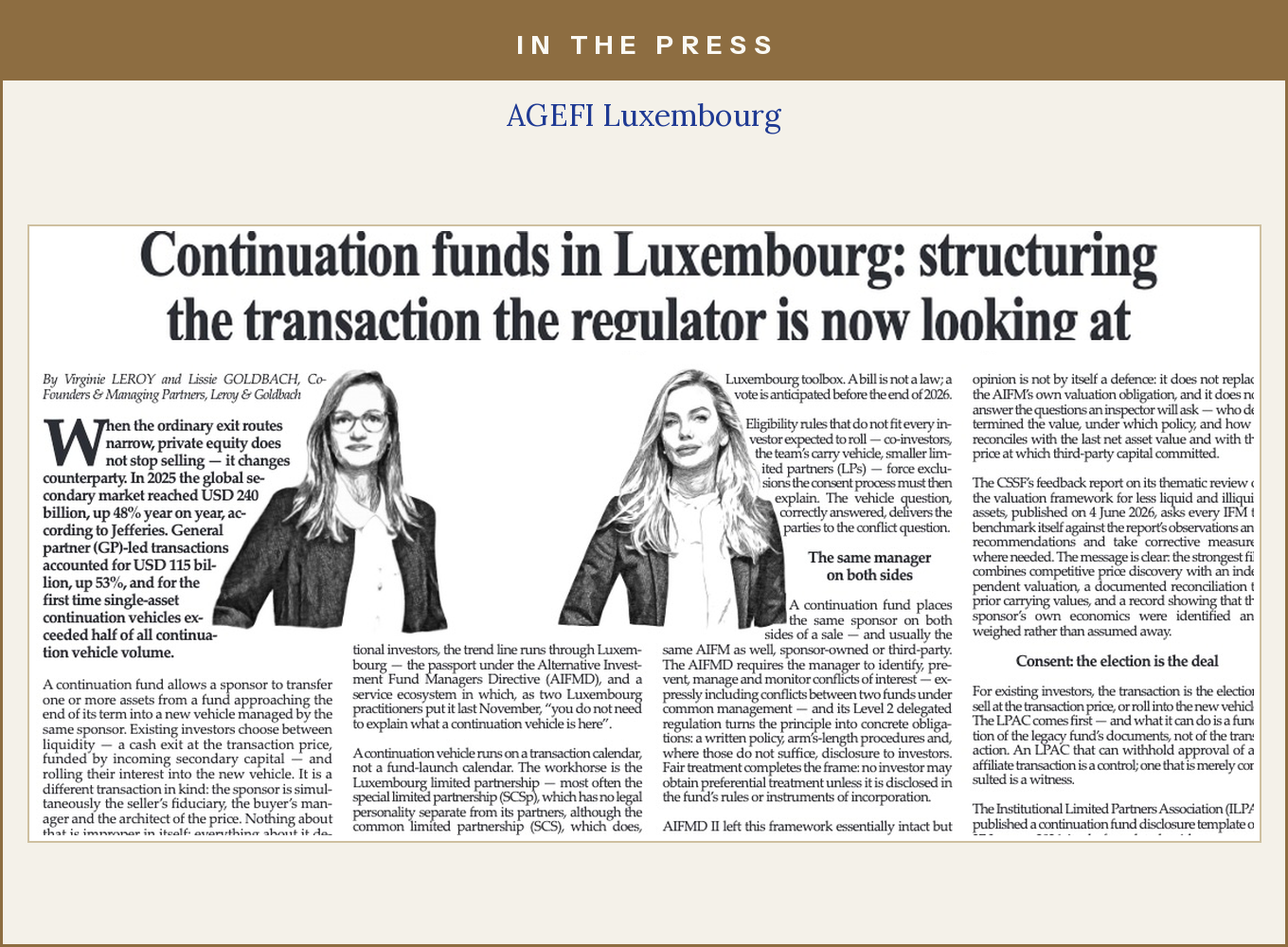
Luxembourg has become the default European platform for US asset managers — and the numbers confirm it. US managers contribute more than EUR 1.2 trillion to Luxembourg fund assets, the largest single-country share, and 53% of North American alternative managers name Luxembourg as their preferred servicing jurisdiction. They cite the reasons that matter most to institutional capital: regulatory stability and investor protection, the EU marketing passport, and a transparent tax regime.
In this article, Virginie Leroy, Head of US Desk at Leroy & Goldbach, sets out what drives the trend and what US managers need to weigh before entering the market:
- Why Luxembourg — pan-European distribution under the UCITS and AIFMD passports, CSSF oversight recognised by institutional investors worldwide, and flexible vehicles (UCITS, RAIF, SICAV, FCP, limited partnerships).
- Common structures — master-feeder, parallel fund, sleeve (LPFS) and alternative investment vehicles, and how to choose between them.
- Reaching investors — the EU marketing passport versus national private placement (NPPR), and the trade-offs of each route.
- Pre-marketing rules — what is permitted, what crosses into marketing, CSSF notification, and the 18-month reverse-solicitation and 36-month de-notification limits.
- Key considerations — substance requirements, service-provider selection, tax structuring, FATCA/CRS, and realistic timelines.
- Recent developments — AIFMD II and UCITS VI (in force 16 April 2026) and Luxembourg's lead in ELTIFs under the ELTIF 2.0 regime.
For US managers evaluating European expansion, Luxembourg combines regulatory credibility with commercial pragmatism. Early engagement with experienced advisers makes for a smoother authorisation process and a structure matched to the manager's strategy and target investors.
To discuss establishing a Luxembourg fund, contact Virginie Leroy, Head of US Desk, at virginie.leroy@leroygoldbach.legal.


.svg)



.svg)
.svg)
.svg)
.svg)
.svg)





.svg)